Building Separated Bike Lanes

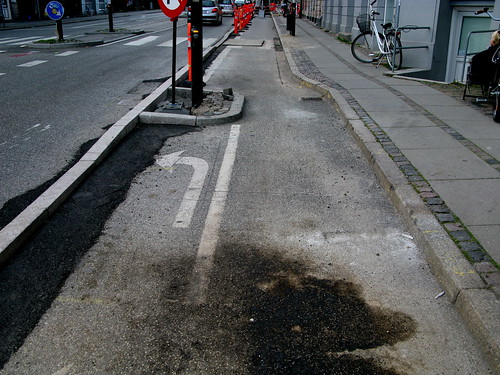
A street around the corner from me in Frederiksberg is being converted from painted bike lanes to separated bike lanes, with a kerb/curb. I ride on this stretch almost every day and I've never felt like the stretch needed a physically separated lane, but I'm certainly pleased it is soon finished.
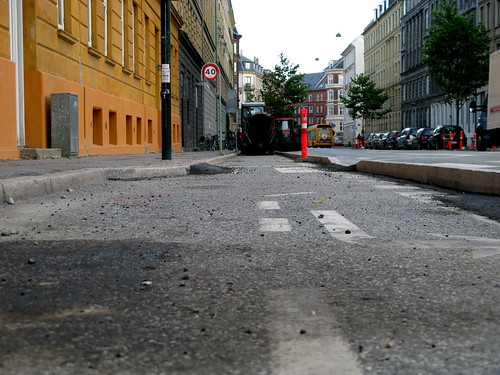
You can see in the photos how they place a kerb towards the street - we use long blocks of stone - and then the gap is filled in with asphalt to complete the safe, separated cyclo-deliciousness.
This is a sign straddle the bike lane at the top of the street reading "The building of cycle lanes will be completed November 2008."
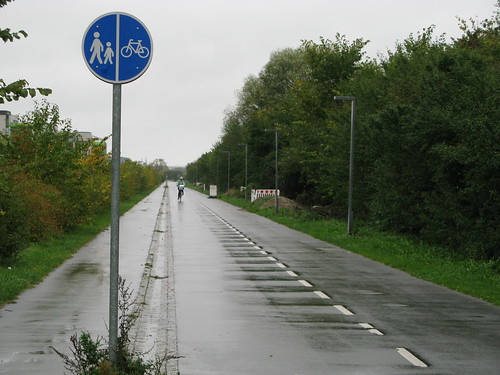
In the new suburb of Ørestad - as with all new development - building bike lanes is a requirement. There are also separated lanes along the main road through the suburb, but here you also get a quieter route if you wish to use it.


5 comments:
This isn't particularly related to bicycling or bike lanes, but you seem to be the best person I can think of to answer my question. If I was to begin to teach myself Danish (in advance of a hoped-for Fulbright to study textiles in Denmark), is there a book you would perhaps recommend? Your advice is much appreciated.
elise
Zak, from a U.S. perspective the width of the cycletrack on the top photo seems fairly narrow. I would imagine some of this is driven by necessity, as I'm sure you don't have a lot of road width in part of the city. As I looked at it, I wondered if the narrow width might be a product of cyclists riding at slower (safer) speeds than we tend to ride in the states. Any thoughts?
I don't know of any book really. Unfortunately. Although the BBC has some phrases you can read and listen to - and download as Mp3 - which might be a helpful start.
Regarding the width... the width of the lanes/tracks often depends on the level of cycle traffic on any given street. In congested stretches with 30,000 cyclists the lanes are 3-4 metres wide in places.
On this street, there isn't any need for lanes that wide. It is wider at the bottom because most traffic turns left at this intersection.
The average width in Copenhagen is 2.2 metres, increasing to 2.5 by 2012.
Thanks for the comment on width- I was about to ask the same question. We've decided we're fed up with moaning about the lack of a bike lane and we're going to start campaigning for one.
I have to laugh when someone says that bike line is narrow! I ride regularly in traffic where my bike 'lane' is a spot with a bicycle picture and an arrow- no painted stripe, no separation from anything. From my perspective, you could drive a double decker bus down that bike path and still have room for bikes!
Post a Comment