
12 June 2009

The Chips Are Up in Copenhagen


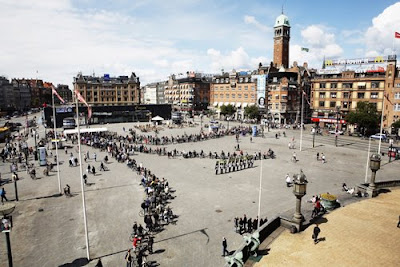
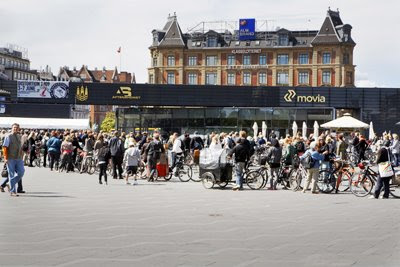
Copenhageners line up on City Hall Square to get an RFID chip installed on their bicycles.

The City of Copenhagen has just launched an innovative program aimed at tracking down stolen bicycles.

The program is called "Få en lille chip på" or "Get a little chip on" and involves handing out 5000 free RFID chips that Copenhageners can put on their bicycles in order to participate in the pilot program that will run until May 2010.

Here's a little film made about the first chip-handing-out event.

Roughly 18,000 bicycles are stolen in Copenhagen each year [there are 1.9 million bicycles in Greater Copenhagen]. Many of them end up taking up space on the sidewalks and bike racks. The City wants to be able to track them down for you but also be able to keep the sidewalks and bike racks clear of bicycles that aren't being used.

On June 4th, Copenhageners could show up on the City Hall Square [pictured] to get a chip installed and so many showed up that many ended going home chipless. The City, however, has more events planned over the summer.

The chips are placed inside a red reflector, which is installed on the bicycle. You have to register to take part - name, address and email.

So... how does it work? If your chip-equipped bicycle gets nicked you do what you'd do anyway. Report it stolen on the police website and inform your insurance company. Easy. If you're taking part in the chip program you can now also report it stolen to the City, on their website.

There is a small army of people walking about the city everyday with the enviable job of irritating motorists. We call them Parking Attendents. :-) They are on the sidewalks of the city writing out parking tickets anyway so they will now be equipped with an RFID scanner so they can walk past parked bicycles, scanning happily as they go.

If their GPS-equipped scanner registers a stolen bicycle, you will immediately recieve an email with a map featuring a red dot where your bicycle was found.


At time of writing, 600 chips were given out on the first day and the rest of the 5000 will be handed out over the summer at various events in the city.

The City writes:
"Copenhagen is a fantastic city to live in. We would like to make it even better for cyclists. It is both green and healthy to ride. Copenhagen's goal is to become the world's best bicycle city by 2015. That's why we taking the intiative to do something about the many bike thefts and, at the same time, clean up the many bike corpses on the streets and in the bike racks. We want to do something that helps you keep your bike. Or, if bad luck strikes, something to help us find your bike for you again."

The long-term plans on the drawing board, if the trial is a success, is to have RFID scanners installed in lightposts near intersections so that if a stolen bicycle rides past, it is registered. This way you can track the movement of the bicycle through the city. At the moment the chips are 'passive' meaning they only respond when a scanner reads them. There is a possibility, of course, to have 'active' chips that tell you where your bike is at all times. Could be interesting to see if that works in the future.

20 thinking out louds:

Anonymous said...

Is this program also available after a night out in town and you "forgot" where you parked your bike?

;-)

Mikael said...

great idea!
although stolen bikes are usually nicked by people after a night out on the town who forgot where their bikes are, so they 'borrow' someone elses... so maybe a program like this would reduce theft.

Su Yin said...

Wow, what a fantastic idea! We microchip everything—passports,dogs,credit cards—you would've thought that this is a no-brainer

karianne said...

Wouldn't the thieves just be able to remove the "reflector/RFID", just as they do grind down the reg numbers on bikes they steal?

... and where will the rest of the events be, for those of us who missed out on the massive queue?

administrador said...

They should put the chip in a random place of the bike, if not the thieves have an easy job to do.

Anonymous said...

am i missing something? ?
a reflector/chip, secured with cable ties, which everyone knows its purpose.
.... pair of scissors/pliers - goodbye.

Mikael said...

every bike has a red back reflector. it's required by law. how on earth are you going to know if a bicycle has a reflector with a chip in it?

and while i'm sure there are thieves who grind down the frame number, the vast majority of bike thefts are done by regular people on their way home from a night out. they don't 'grind', they just go home. :-)

i'm sure if this pilot program is a success, the chips will be randomly placed.

to find out about the next event, join the newsletter here.

Anonymous said...

i hope it is a success.
the reflector as it is, is going to be very obvious as a pilot chip reflector. they all look the same, no?
or are they installing chips inside already fitted reflectors? - its not clear. i doubt it makes much difference,
wont take long for word to get around about this device and the scheme.
first thing any thief is going to do is notice/check the reflector, twist it and break the cable ties. discard reflector.

chip hidden randomly somewhere inside bike - pilot would probably be much greater success.

Mikael said...

1.9 million bicycles.

5000 test chips installed in anonymous reflectors on anonymous bicycles.

i seriously doubt it's going to be a problem.

Anonymous said...

obviously a very different culture from here in uk.
we have very organized thieves, professionals.
not many of the bikes stolen here, are by drunk people after a night out ;)

jb said...

I didn't know theft was such a problem in CPH. When we were there last month, we brought back a bike to the states for my girlfriend, and it came equipped with one of those little rear wheel locks (a joke in the USA!). I was under the assumption that they actually worked in CPH and people didn't steal the bikes if it was locked this way. Are U-Locks useful in CPH after all? Sorry to hear that my idyllic view of bikes not being stolen in CPH is not true!

Mikael said...

they are useful. quick and easy. every bike I've had stolen is because I forgot to lock the wheellock.

like anything else you just have to make sure the lock is of good quality and that you lock it correctly.

spiderleggreen said...

sounds like you have a lot less bike stolen than Amsterdam. why is that?

Anonymous said...

Here in York (UK) the police ran a similar scheme but the chips were rammed down the seat tube, so thieves would have to take the saddle off and poke down the tube with some contraption to dig out the chip. I got one of these chips in my Gazelle a couple of years ago.

But we don't have traffic wardens randomly checking, so the authorities only know where your bike is if they happen to find it after you've reported it stolen. It's more a means of confirming it's yours rather than actively hunting it out.

whitewashasian said...

problem is if the thieves knew where the chips are-it'll be easier for them to take it off. but hey, the RFID chips are a step in the right direction-about time though, this technology has been around for a long time-glad to know it's being utilized on a larger scale for bikers.

Mikael said...

Anon in York: cool idea. In Denmark we have frame serial numbers required by law if you buy a new bike. if a stolen bike gets found, the police ship it off to the insurance company in question, trackable through the serial number.

jb said...

I wish the wheel lock was enough deterrent in the US, but alas, we have very determined thieves here! Nevertheless, the wheel lock on my G-Friend's bike brings us a smile when we use it here in the US (along with a beefy cable lock) since it reminds us of our fun trip to CPH.

Kelvin said...

Imagine a city where there are very few drivers, and there's a disproportionate number of luxury sedans and expensive sports cars. No wonder the thieves are more determined: you're screwed even with a cheap bike because the thieves are equipped for the big fish. Ditto with the bike theft situation.

Safety in numbers: it works even when you're off the road!

Melbourne Cyclist said...

I can see there being privacy objections to the idea of active RFID chips, since they could be used to track where a person is, but this (passive) scheme sounds fantastic!

I'm lucky enough not to have had my bike stolen - yet - but I have 'lost' a front light (when I forgot to take it off, broad daylight on a busy street), my emergency pump, and my extremely disgusting, never used, came free with the bike, covered in road grime, water bottle. That last one worried me - I wasn't keen to touch it, so I hate to think who stole it! I'm now seriously considering changing my quick release front wheel to a non-quick release wheel, just in case. My bike's not expensive, but I am pretty attached to it.

Coyote said...

I thought there was a problem with reading and RFID chips' signal inside a steel frame?

Anyway it is a great idea as long as participation is optional.