
23 October 2009

Volvo Tries to Brake for Pedestrians


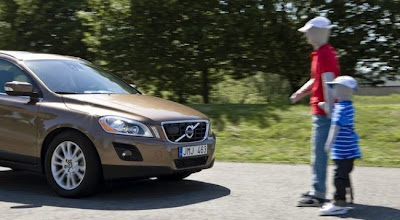
Volvo is wrapping up testing their new - and clumsily named - Collision Warning with Full Auto Brake and Pedestrian Detection to be included as extra gear in their new S60 model.

What that means is that the car is designed to detect pedestrians and a prototype has been driving around Copenhagen to 'train' the system.

It is meant to spot all pedestrians in front of the car as well as off to the sides in a 60 degree angle. It will warn the driver with a red flashing light on the windshield if the car is on a collision course with a pedestrian.

If the driver doesn't react quick enough it will brake automatically up to 25 km/h and stop by itself if the car is travelling under 25 km/h.

Copenhagen was chosen as a test city because we have a lot of pedestrians. The test car's screen shows pedestrians popping up. Sometimes cyclists show up but urban inventory like trees and posts don't register.

The Danish daily newspaper Politiken took a test drive and they asked why cyclists weren't included. Volvo replied that they are taking it one step at a time. "Cyclists will perhaps be next on the list, and then animals. It is very complicated to teach the system to read pedestrians' form and structure and separate them from other objects. Because it's just as important to not send false warnings as it is to register pedestrians. If the system beeps, warns and brakes too often, the driver will tire of it and shut it down", said Martin Magnusson from Volvo.

Therefore the system developers have been all around the world for months in order to teach the system to recognize all the different kinds of pedestrians and to learn different weather and light conditions. The system doesn't work at night.

The development of this system has taken 10 years. Pedestrians were chosen first because 16% of all traffic related deaths in Sweden are pedestrians and 11% of all serious injuries in accidents are pedestrians. They are the high risk group. The speed is under 25 km/h in half of these accidents which is why a total automatic stop will have an enormous effect. And a reduction of speed from 50 to 25 km/h will reduce the risk of death by 85%.

"A completely concentrated and sharp driver is always the best option, and better than this system. But research into a long list of collisions show that the driver was occupied with something else other than driving in 93% of the accidents. And half - 47% - didn't even have time to react because of the distration. This is where our safety system comes into play", said Jonas Tisell, who heads the project for Volvo.

--

So this sounds like somebody who is not actually ignoring the Bull in Society's China Shop. The idea sounds interesting. Not unlike the Dutch project to place airbags on the outside of cars [which is so far developed that crash test dummy tests are scheduled for later this year].

There is the chance that drivers will be lulled into yet another false sense of security by this system. John Adams, Emeritus Professor of Geography at University College London has an excellent blog called Risk in a Hypermobile World where he, among other things, questions the hype about the effectiveness of seat belts.

What say you all? Good idea this Volvo thing? Or not?

18 thinking out louds:

Kim said...

The problem with this sorts of solutions is that drivers start to think that they don't need to take responsibility for their actions as the car will do that for them. Volvo may be doing this with the best of intentions, but the road to hell is paved with good intentions.

Anonymous said...

What Kim said - never mind training the car, when did we give up on training the drivers? Stopping for pedestrians is so basic, so rudimentary, that it really needs to be a major part of any driving test, and the tests need to be applied frequently and aggerssively. What this does is encourage incompetence and inattention. Unfortunately, it also seems to be the wave of the future; soon coma patients will be given driver's liscences (actually, it sometimes seems that that they already are). Val

kfg said...

As a driver I like bucket seats and a nice, sturdy five point harness. As a cyclist and pedestrian I like bench seats without retention devices and a big, sharp spike sticking out of the middle of the steering wheel.

The bull ought to face consequences for its own actions.

As for the Volvo thing, I can understand and appreciate its motivation; but can't help but feel it will do little more than further degrade driving skills and foster an impression among drivers that they no longer have any responsibility whatsoever for paying attention.

And even if they should desire and strive to pay attention and remain in personal control of the vehicle, experience with ABS shows that merging human operator control with automated control systems just creates confusion about who is in control of what, when and how.

If you don't want to drive; take the bus or train.

KDT said...

I can see Volvo running initial tests in CPH, where pedestrians actually pay attention to the walk/don't walk signals. What happens to that poor car when they bring it to NYC, where the crossing signals are little more than pretty flashing lights that help liven up the streets, and pedestrians wander around on the roads like they're auxiliary sidewalks? CWWFABPD overload, that's what.

Andrew McDade said...

Bike Snob NYC suggested (tongue-in-cheek, of course) awhile back that if you must drive, your car should have a displacement no greater than 1,500 cc's, be manual transmission, and air-cooled. When your car forces you to pay attention to it, you will. These comfy, smart cars produce drivers that are even dumber and less aware.

Michael Hartford said...

@kfg

"If you don't want to drive; take the bus or train."

Exactly!

Ed Scoble said...

Kim says it the best, the more advanced cars gotten, the less responsiblitiy the drivers have for their action.

take speed for instance, in the past speed were lower than now on motorways due to the lack of safety that motorised vehicle have, not just seatbelt, but airbag, crumple zone (not as well developed as nowadays), drivers are more cautious (at least in my opinion, I didn't base this on any finding).

nowadays with the amount of safety cars have, drivers have less to worry about and just concentrate on driving, especially with big SUV, even less to worry about themselves getting killed.

tensimon said...

agreed, any automation takes away responsibility. Drivers SHOULDN'T BE DISTRACTED because they shouldn't be doing anything but DRIVING when driving.

Besides, rigorously enforced 30km/h limits would remove most need for these expensive technological 'solutions'.

In my neighbourhood (Okinawa) there are even 20kmh zones - but since nobody (except me!) takes any notice, there isnt much point.

Anonymous said...

And when the system doesn't recognise a pedestrian, & s/he is killed, is the driver or the manufacturer to blame?
/melbourne

Mikael said...

oooh... interesting question!

Anonymous said...

What anon in Melbourne said:
..And when the driver claims an emergency-stop was a false alarm - and sues for damages for whiplash...?
Or the vehicle behind crashes into a thinking-vehicle and one driver or other disputes that an emergency stop was necessary...?
(This stuff is bound to happen in the US or UK)
- WeeE

Erik Sandblom said...

Apparently other car companies are working on a similar system which is expected to save four out of ten pedestrians.

Dagens Nyheter: 4 av 10 fotgängare kan räddas med ny teknik

Of course it sounds nice to save lives, but I can't help but think that if people would choose to walk, cycle or take public transport, even more lives would be saved. In Sweden, Germany and England, half of all car journeys are shorter than five kilometres, which takes 20 minutes by bicycle.
Ecoprofile: De flesta rör sig inom tio kilometer

In the UK, car drivers killed 1000 other road users in 2007. Busses only killed 84 people. Source CTC A single buss can easily take 10-40 seated passengers, which means you don't need as many vehicles to transport the same amount of people. Trains take even more passengers with even higher safety.

Finally we have car-related problems like congestion and obesity.

All this talk of safe, green cars sounds like light cigarettes to me.

Melbourne Cyclist said...

I'm in agreement with everything said about how "safer" cars make more dangerous drivers.

Personally, I'd like to see automatic driving licence expiration with a five or ten year limit, and mandatory re-testing in order to have it re-issued. I'd also like to see all driving tests involve a cycling component, and safe/legal-cycling lessons in school / provided by a road safety authority, with some kind of "I passed basic road skills" certificate - some cyclists clearly have less of a clue about the road rules than motorists, and given some of the motorists here, that's saying a lot!

I'm also coming around to the idea of cyclist licences here in Oz, simply because it would give us the legitimacy we should have (I pay my taxes dammit, which pay for roads!), but are sadly lacking. Nominal fee perhaps, just to underline the point that cyclists pay for roads just like motorists do, fee waived for everyone in full-time education (maybe link it to attendance rates?).

Anonymous said...

I am a bit surprised at all those 'negative' comments. Volvo is just a car-maker, so they are just doing their job, probably better then other carmakers. What more can you expect from them ?

You also have to put this in context : in Sweden people drive relatively slow and safely compared to say...Brussels (I have long experience in both cities). Typically if you have an accident in Sweden, it will be with a mom who was speaking to her child, a man on the phone etc. In Brussels it will be people accelerating to catch the red light (I know it's stereotype, but in vast majority true).
Not that anyone should be considered 'not responsible' for their action, but in countries with educated drivers I find it great. Because as a biker and pedestrian (think about kids playing in the street) we also have unsafe behaviour sometimes.

BTW I'm pretty sure most drivers would disable the function in Brussels, because THEY know how to drive their big-ass SUV :-(

Erik Sandblom said...

Anonymous, "Because as a biker and pedestrian (think about kids playing in the street) we also have unsafe behaviour sometimes."

Well not really. In the United Kingdom in 2006, car drivers killed 1049 other road users, while cyclists killed only five. Similarly, in Sweden in 2002, car drivers were responsible for 46% of others killed; cyclists only for 0,3%. Se graphs and sources here:

Ecoprofile: Krockar trafiksäkerhet med miljöhänsyn?

Anonymous said...

Hej Erik,

I think you misunderstood me. I don't say cyclists or kids will kill someone, I just say that we are not always having 100% safe behaviour (risk is usually only for us though). In that case Volvo's system might help.
Of course without cars there would be almost no fatalities. I wish it could be like that.

mvh,

Steven Vance said...

When I drive (once a year, maybe less often), I'm my own Pedestrian Collision Avoidance System. I have two eyes, I follow the rules of the road, and I watch for all street users, and I expect the unexpected.

spag said...

This system will simply have the effect that the drivers of these cars will be constantly on their blackberries without the slightest sense of guilt, knowing that the car will stop for pedestrians anyway.