
Lyngby Cycle Track Design

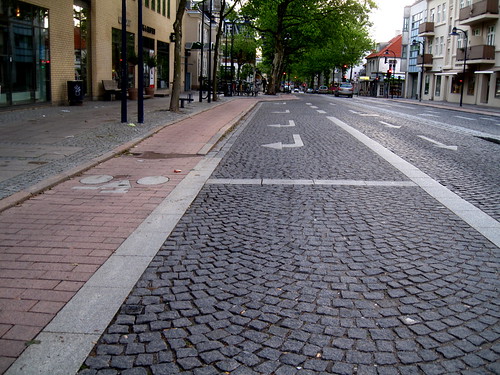
I visited the town of Lyngby, just north of Copenhagen, a couple of weeks back. It's actually called The King's Lyngby - Kongens Lyngby - but this ain't no history blog, now is it. The main street through the town centre is a lively, people-friendly stretch with loads of small shops. The city has laid out rough cobblestones on the street as a kind of traffic calming measure, mixed with old school aesthetics.
The cycle track is also unique in it's design, small paving stones to create a smoother surface. At this intersection, the stop line for cars is a good stretch back whilst cyclists can continue up to the pedestrian crossing, from where I took this photo.
We're seeing a marked increase of stop lines for cars pulled back from the intersection, not least in Copenhagen, as reported a while back.
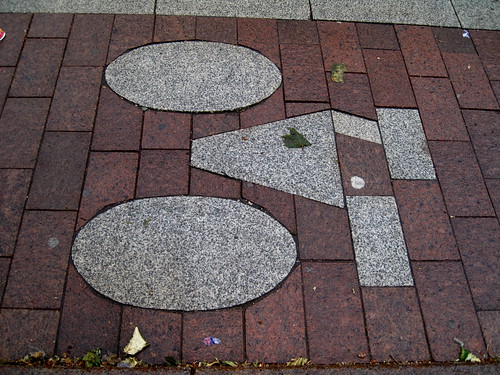
The pictograms are also quite unique on the cycle tracks, which adds to the general 'look and feel' of the urban design. I ain't no stone mason but the wheels tell us that cutting circles isn't the easiest task.







14 thinking out louds:
The surface is indeed nice, but the path seems a little narrow.
The street seems rather thin, how about no path, more plants (though not sharrows)?
Cobblestones are lovely, good to get water in the ground.
But above 20km/h auto tyres make a lousy sound.
Use that cycling surface for half of each side.
(Please fill this sentence in as you like but end it with "ride").
Yes, slow speeds, more green, more benches even... that would get me in the mooood.
Or make it carfree -- now that would be gooood.
Do cars actually stop back from the intersection when instructed to do so by the markings on the road? In New York, it's a miracle when they stay out of the crosswalk.
Classic!
@Mike:Speaking very generally, it is my experience that they do. One important factor regarding driver behaviour change and respect of things such as this is that many Danes cycle regularly, and nearly all do at least sometimes -- in other words, drivers are also cyclists, and vice-versa... people know both sides of the windscreen.
Getting as many people as possible out of private automobiles for urban trips needs to be the main goal, but I think it would be great if all driver's licenses required cycle training or testing.
Only a true artist can draw a perfect circle - and stone masons are merely craftsmen.
Hi, hope it's OK to contact you here. We would love to include your blog on our giveaway blog network: Giveaway Scout (http://www.giveawayscout.com). Have a look and if interested, use our online form to add your blog (http://www.giveawayscout.com/addblog/ ). thanks, Josh
Bu Mikael, this is yet another example of not actually doing enough. Copenhagen has far too many injuries to cyclists caused by right turning motor vehicles crossing the paths of cyclists.
It's quite similar to the Dutch situation from 20 years ago, when advanced infrastructure for that time would place the stop line for bikes further on than for cars, and give bikes a green a few seconds before cars. However, they've moved on from that now and it's not similar to what they do now.
@David, those examples are great - in particular the ADG when it is actually green! It reminds me of China at its most bike-friendly - but all of those are very wide streets or even rural situations -- I don't see why - at the very least - main streets and centres need any automobile traffic at all.
Groningen handles this quite well, does it not?, with a main centre area which most automobiles cannot cross -- though there is a bus.
No cars, no signals.
***
I did my own investigation of this photo and the results are based on a guess that images from Google Earth are as contemporary as Mikael's:
The intersection is Lyngby Hovedgade (Lyngby Main Street) and Jernbanepladsen, facing roughly N-NW.
That cycle track in the photo only extends one block. Further to the N-NW - the street gets narrower and the pavements get wider - there is a speed limit of 20km/h and of course no infrastructure.
I am not claiming that this section of separated path is bad, though it seems a little schizophrenic. It is the edge of the centre and cars are being more accommodated than they they are a block away. I do think that showing the 20km/h section which extends for two or three blocks - and seems to have no curbs either - is a better example for town centres.
Now, if it could only be carfree! Alas, Lyngby is rather affluent, even compared to Copenhagen... but is that a good excuse?
GIF: The first example is actually on quite a narrow road. It's the same width as one in Cambridge where it is claimed that there is not room for such provision.
However, you're right. It's simply not necessary for streets in the middle of cities to be dominated by cars, and in Dutch city centres you don't tend to find many cars. This is true in Groningen, Den Bosch, Utrecht and also here in Assen. These all provide better examples of what needs to be done.
I bring this up only because of Michael's unprovoked attack on people who try to discover the safest ways to bicycle. In general I try to leave people to their own preferences.
But Michael well knows this is a very dangerous design for bicyclists, yet he always champions them. Why. It is as if he wants bicyclists to be injured and killed. It is inexplicable to me.
In the recent study conducted by the city of Copenhagen that we have discussed before, this design as well as all other designs resulted in significant increases in the injury rate to cyclists. No amount of pretty paving is going to change this.
The correct translation of Kgs. Lyngby is, I think, "King's Lynn".
Sometimes I'll take style over quality, this is one of those times. While it may not be best practice, it is a testament of the city's and country's commitment to cycling. Nice picture.
-Sev
@Green Idea Factory: I totally agree that driving tests should include a cycling component - having the road full of people who appreciate "both sides of the windscreen" regardless of what mode they're in/on today would be simply wonderful :-)
Post a Comment