
Good news from Berlin, it seems. The Berlin Senate published the City Transport Development Plan [Stadtentwicklungsplan Verkehr] last Friday and, by 2025, it aims to:
- Increase cycling's modal split from 13% to 18%
- Increase public transport's share from 27% to 29%
- Decrease car traffic from 32% to 25%
Parking fees will rise drastically but public transport ticket prices will rise only modestly, in order to encourage people to leave the cars at home.
To promote more cycling the plan will involve rebuilding roads to provide more infrastructure for bicycles. There is also talk of a bike share programme to compete with the Deutsche Bahn's Call-a-Bike system.
It seems that the demotorization of western societies continues. The number of 18-24 year olds who own a car has fallen to 16% from 24%. This may because of unemployment, but it mirrors a tendency in other countries like Japan and the States.
Here's the article from Der Tagesspiegel.
12 thinking out louds:
"The number of 18-24 year olds who own a car has fallen to 16% from 24%."
Surely it's fallen from 24% to 16%?
Good news if so!! :)
I wouldn't take these figures too serious. By 2010 the bicycle share was supposed to reach 15% according to the last plan. So this failed and why shouldn't it fail again? If there is hope to find, then that the green party has an increased interest in supporting public transport and bike use in Berlin. Forecasts say, that they have a good chance to win the elections in 2011. However, when you read the comments underneath the Tagesspiegel article, you can get a nice impression of what the automobile part of the Berliners think about increasing the bicycle share... So I guess it will take a long time to convince "average people" about it.
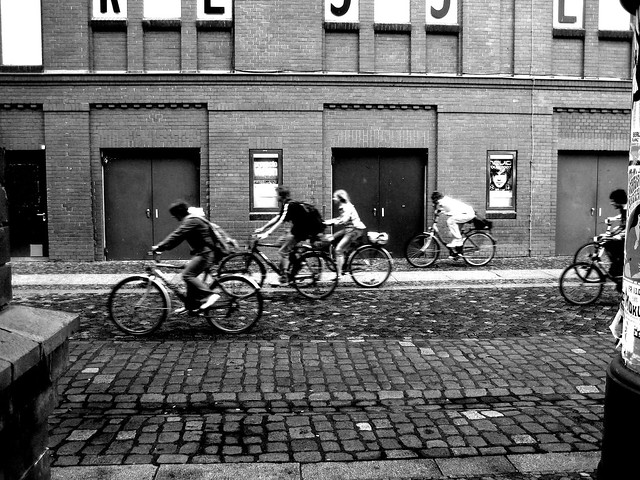
My first thought was that the two photos show the reality of cycling in many parts of Germany, or at least Berlin: Cycling on the pavement and cycling on what was the pavement (for the latter you can see that a cycle path was cut out of the former wider pavement) and also someone - it seems - going the wrong way.
The article talked only about infrastructure but I wonder if any training is planned for adults: This is needed for many native-born Germans who have never really cycled so much in the larger cities and immigrants from both N. America, Southern Europe and the Global South. There is ZERO training (in Berlin) from the government nor ADFC, except for elders (and they get a free reflective vest, too!) Not knowing how to use a bell, speeding by pedestrians, etc., etc. I have kvetched about this before in this forum but for some reason Mikael did not ask me about Berlin, perhaps because I would not comply with a wish to call them all "Citizen Cyclists".
But sure, there is a higher bike modal share now, at least among Europeans and N. Americans in certain districts. Who can blame people who can get a cheap bike with no lights for half the price of a monthly transport pass? Someone needs to do a film on them -- in fact Vehicular Cyclists and Cycle Chic-brand Citizen Cyclists would agree on the appalling lack of skill and courtesy of many cyclists in Berlin.
The A100 highway and U-Bahn mentioned in the story are insanely expensive and stupid, and of course the A100 will cause environmental destruction by making it an easier go for many drivers to several districts in the former East, in addition to the noise and whatnot.
Articulated buses instead of trams in in the center of a Western European capital of over 3 million people is total nonsense. Those U-Bahn and highway projects could pay for the restoration of tram service to a lot of western Berlin.
The bike parking at the main station in Washington, D.C. is better than what's at the main station in Berlin, and bike parking at most S-Bahn or U-Bahn stations is primitive or worse, or non-existing.
It seems that the current administration in Berlin made all these statements to work against the strengthening Greens, who want to do even more.
German citizens and residents and new immigrants need to develop a love for walking in the city and a gradually-increasing sustainable hate for private automobiles. More - and more respectful - cycling will come as a result.
Good stuff is happening in Europe but, it pains me to report, not in all parts of the 'western' world:
http://sexify.wordpress.com/2010/11/18/something-has-got-to-be-done-about-new-zealand/
Adam
Here's the 2008 Plan for the City of Kiel, which also contains some interesting statistics: LINK
According to a 2004 survey, the overall percentage of bicycle-bound transport in the city was 17% (while it used to be 8% in 1988). In detail:
Distances < 1km: 20%
Distances < 5km: 23%
Distances < 10km: 12%
The plan aims to raise the overall percentage to 25% within the next years by massively expanding the (already quite extensive) network of velo routes, bike parking and lots of other steps.
I live in Kiel and use my bicycles very frequently (actually, Kiel is a very nice city to ride in). So I am happy to see that the city of Berlin is about to follow Kiel's good example and encourage it's citizens to use their bicycles more often.
Yes, I think many young people don't own their car for some reasons.
Anyway, the news from Berlin sounds great. It looks like a crusade of Portland in the US which I found the other day.
Then, I think a sub lane is important to promote bicycles in the city, that I have mentioned related to Seattle's Srallows project.Please check it out below. Thanks.
http://mamabicycle.blogspot.com/2010/11/joyride-mias-blog-review-seattle.html
shuichi
@ Stefan
I think it is a bit wish-thinking to say "that the city of Berlin is about to follow Kiel's good example". Kiel has a motorized share of 47% compared to 34% in Berlin. Probably the decision makers here around don't even know too much about a remote city with 240.000 inhabitants. If at all, they probably focus on the known examples like Münster and Freiburg - all being roughly the same size as Kiel. I doubt that any city can make up for a "good example" at all. The local conditions are far too different to speak of that. However, pointing to Kiel as a bigger city which is increasing its bike share is not less important than to point to Freiburg, Münster, Groningen, Copenhagen. It will encourage people who fight for their own cities way of rising the bike share. Most big western cities still count on the car - not Berlin. It is the biggest city in Germany and still it has the least level (317/1000) of car-ownership in big cities (Germany overall figure is 566/1000). Berlin with its 3.4 mio inhabitants has a diameter of ca. 40km. In the city center and in certain districts the bike share is impressive even today. To raise the bike share here is more difficult than to raise it in a city with 5-7km diameter, a distance which you easily can cover by bike. Together with public transport, this sounds feasible. Unlike e.g. in Hamburg you can even take your bike along in S-trains, tube and tram during rush-hours. There's a lot to do, e.g. bike parking is by no means on a level with dutch cities or Copenhagen - but things do change. Too slowly in my eyes, too quickly in the eyes of car fetishists.
@Michal S: That sounds about right, BUT one important question is how many new cyclists are coming from collective PT and how many from private automobiles. This gets addressed e.g. in analysis of public bike systems but not in simple bike share goals such as the ones mayors like to declare.
Saving seats on PT for people who need them more is good, and if there is a lot of mode shift to cycling it can make the bus, etc. more pleasant for people who drive normally or of course just reduce demand for larger vehicles (though hopefully not create longer intervals). But if the shift only comes directly from collective PT the streets may have just as many cars, though safety in numbers shall improve things for cyclists.
Ironically, I think, here in Berlin quite a few parents or mothers with children switch from cars to Niholas, or Bakfiets or Christianias etc but then ride on the pavement.
@ Green Idea Factory
Going in a Nihola on a narrwo two lane 50km/h road needs nerves of steel and a strong believe in the statistics that tell you about it being safe. I'm afraid this will keep going on until one of these lanes is crowded with cylists. At least these mothers have stopped endangering other mothers with their Niholas. Since using a car is dangerous for the Niholas on the pavement and the pedestrians as well, I guess this deal is not that bad for the pedestrians either... Got it? ;-)
In case you haven't looked at your calendar lately, Berlin will have a state election in 2011, so this announcement is for me no coincidence. The CDU (conservatives) and the FDP (lib-dem) are in the doldrums. I think it's pretty safe to say that the game this time will essentially be to decide how the next coalition will composed from the SPD (socio-dem), the B90/Grünen (greens), and/or the Linke (neo-communist).
The Grünen have been very popular lately, so much that they start actually seeing themselves as
becoming the senior partner in any coalition, an absolute novelty in Germany. The incumbent SPD therefore feels suddendly compelled to take any pot shots at their challenger, and profile themselves as pedestrian, bicycle and public transit friendly, but their deeds of the last years speak much louder than their late promises. I understand that the bike budget of the Senate works out to about 1EUR/inhabitant/year, much of it spent in advertising.
I've seen many more streets converted to perpendicular or sidewalk parking than streets with bike path improvements. Parking is mostly free even and unregulated in central districts, with the result that people will leave junk such as trailers and trucks lying about for months or years on end.
Streets such as the Linienstr. are declared "bicycle streets", but in fact you only need to use these a couple of times to see that they don't really offer anything more than before, there is no new space for bikes, and car drivers (illegally) transiting through these are just as aggressive as usual.
The Grünen they're up against are just as ineffectual. I used to live in Kreuzberg where a section of the Bergmannstr. too was declared a "Fahrradstrasse", but it was the bit which is out of the way and sleepy, and not the lively one where stores and restaurants are to be found. In the latter section the car is still as king as ever, with free parking everywhere and "informal" supplementary parking on the sidewalk. If it wasn't enough, the Greens are very proud of their real estate project (clinics+stores), with 180 parking spots where there was none before - but it took about two years after the grand opening for minimally usable bicycle stands to be installed.
You will notice that the ADAC (Automobile Club) is mentioned in the article, they pretty much still have the last say in everything related to transportation, and German journalists are quite subservient to them.
I'm now back in Montréal, I find the central districts much more people-friendly than Berlin's. However in Berlin you can get in and out of the city on your bike, the same is not possible here.
Excellent analysis from Anonymous in Montreal. The "Fahrradstr." mentioned is still a sort of shortcut between two somewhat gentrified shopping streets, so still useful, but yes the two streets themselves still have 2MC2F*.
You would never know this was a district controlled by the Green Party (and even an anti-war rep. in State parliament) unless of course you compared it to the other districts in Berlin!
* Too many cars, too fast.
@Michael S:
Of course it's not really possible to compare Kiel to Berlin, Hamburg or Munich.
But nevertheless it can be a good example regarding the efforts that are made to encourage people to ride their bikes. In Kiel, those efforts have obviously been made much earlier than in other german cities and the positive results can be seen very clearly by now.
I fully agree that cycling is probably more attractive if you can reach virtually every place in the city within less than 20 minutes by bike. Also, in most cities of ~200.000, public transport is limited to busses which results in a much higher car traffic percentage as most people will choose their car over a bus (busses are, compared to S-trains and the U-Bahn, uncomfortable and slow). So in my opinion you can't blame any city without trains for having a high percentage of individual car traffic...
By the way, according to the ADFC's 2005 Bicycle Climate Test (Link) Kiel comes second just after Münster ;)
Post a Comment